
A timing belt that lasts 300,000 km: Volkswagen boasts about the 1.5 TSI engine and an unusual technical solution
The 1.5 TSI engine from Volkswagen stands out for its efficiency and technology, but it hides a peculiarity: its timing belt is a rarity that can last up to 300,000 kilometers, although checking its condition is not easy.
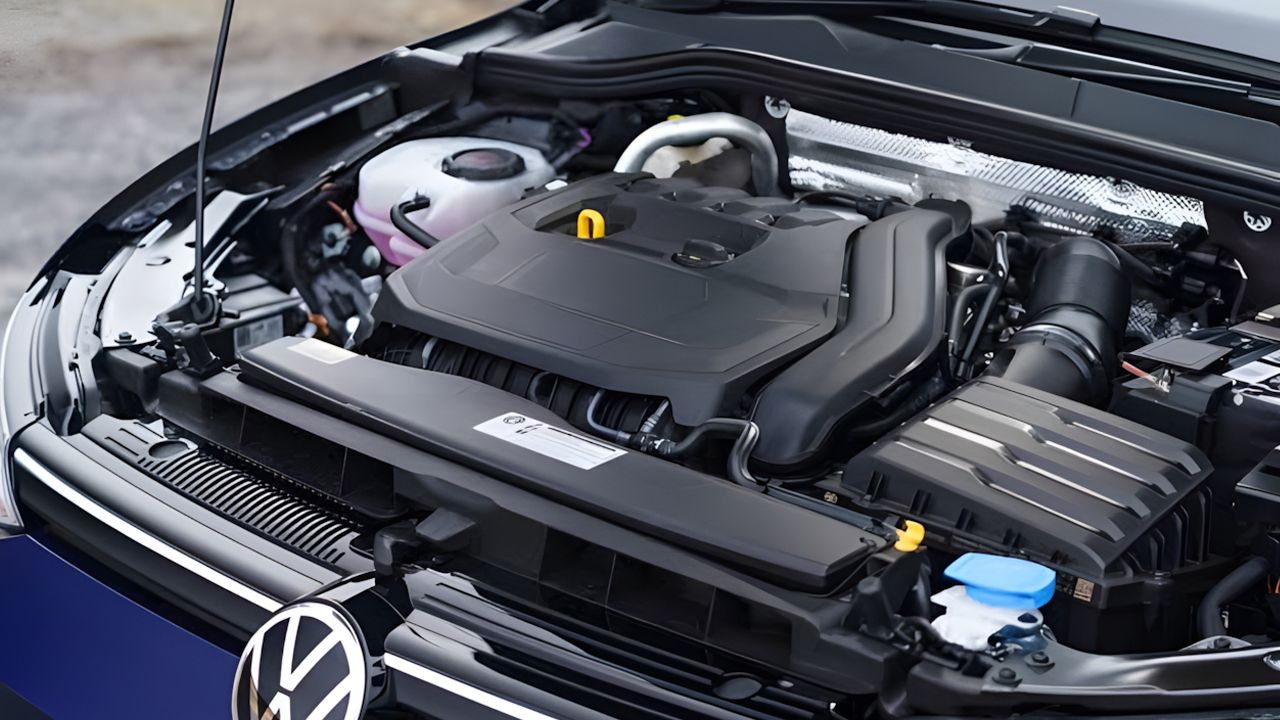

The world of timing belts gained special importance that it had rarely experienced when Stellantis challenged the limits of rubber. The durability of engines was a challenge that the giant wanted to overcome with a generation of blocks that promised to combine efficiency and longevity. However, the limits of materials eventually questioned that gamble.
Internal combustion engines will remain relevant for a long time, and Volkswagen has been working for years to refine one of its most important gasoline engines. The 1.5 TSI has evolved to become an efficient, technologically advanced mechanism with a considerable presence in the Group's lineup.
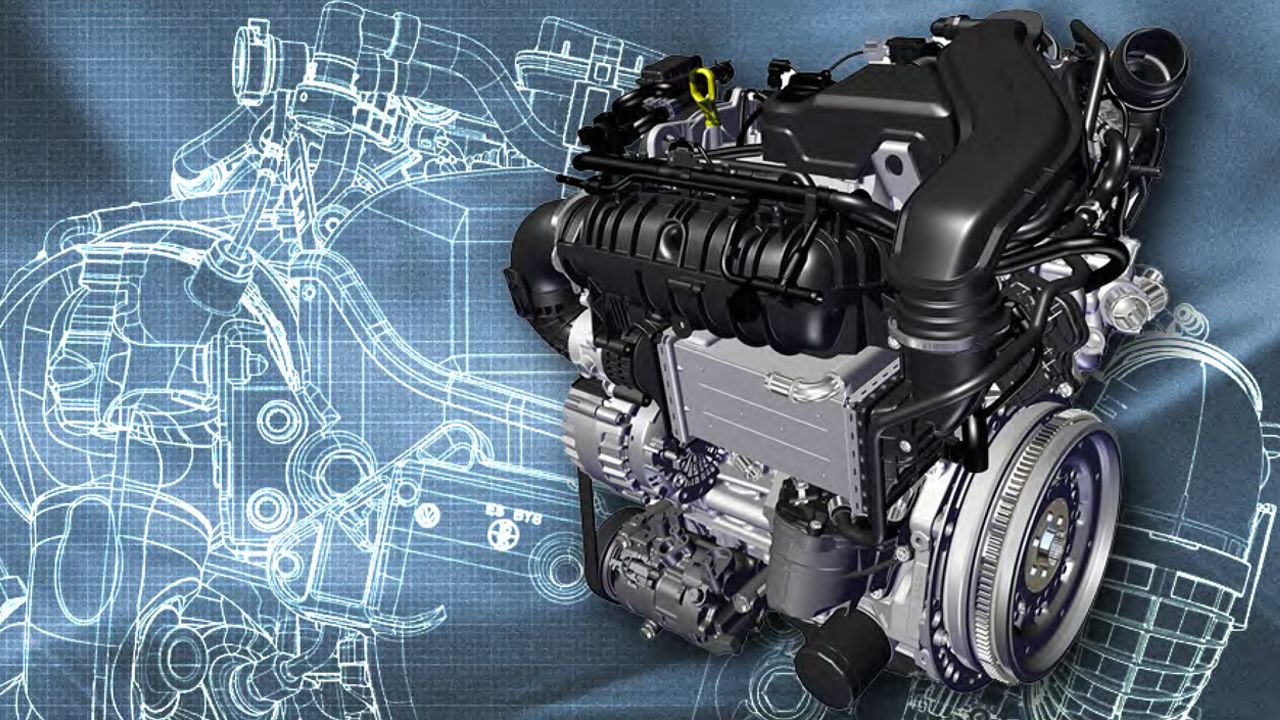
The 1.5 TSI has become one of the most important engines for Volkswagen
Since its launch in 2017, this gasoline engine is the only one along with the 2.0 TSI in all models from Volkswagen, Audi, Skoda, CUPRA, and SEAT built on the MQB transverse engine platform. Depending on the generation of the block, it is equipped with different technologies such as cylinder deactivation (not available in the PHEV), improvements in combustion, mild hybridization, and a key part in the PHEV and new self-recharging hybrid.
But it also hides an unusual technical solution that, on paper, seems like an extraordinary advantage: a toothed timing belt designed to operate for an exceptionally prolonged lifespan, during hundreds of thousands of kilometers without the need for periodic replacement. This is supposed to be the great advantage of timing chains, but without their weight.
However, that same solution has a peculiarity that is not so convenient when it's time to check its condition. The timing system is protected inside casings that prevent dust and dirt from entering.
For a visual inspection, it is necessary to remove three covers located on the left side of the block (looking at the vehicle from the front, on the passenger side). An intervention that complicates an operation that in other engines is much simpler.
The belts in the Volkswagen 1.5 TSI gasoline engine
The solution has an evident technical logic. A toothed belt is subjected to constant mechanical stresses and the presence of contaminants can accelerate its deterioration. Minimizing exposure to these elements helps to prolong its lifespan. But it is also an intervention with a cost that would not exist in a conventional visual inspection.
Because the only belt that can be observed is the one for the alternator and automatic climate control, which is located just below. Additionally, in the 48-volt eTSI versions, it must also be considered that it powers the motor-generator, which allows the combustion block to be completely turned off while the vehicle continues moving, restarting when necessary.
This has an evident mechanical consequence: while the engine is off, the timing belt does not turn. The same can be applied to the 1.5 TSI Evo 2 of the plug-in hybrid, which, by its nature, allows the thermal engine to remain off during many journeys.
But the drawback is not only when someone wants to check how that belt is really doing, but also that Volkswagen defines this system as «maintenance-free». A designation that does not mean its components are indestructible, but rather that there is no conventional periodic replacement scheduled for certain applications.
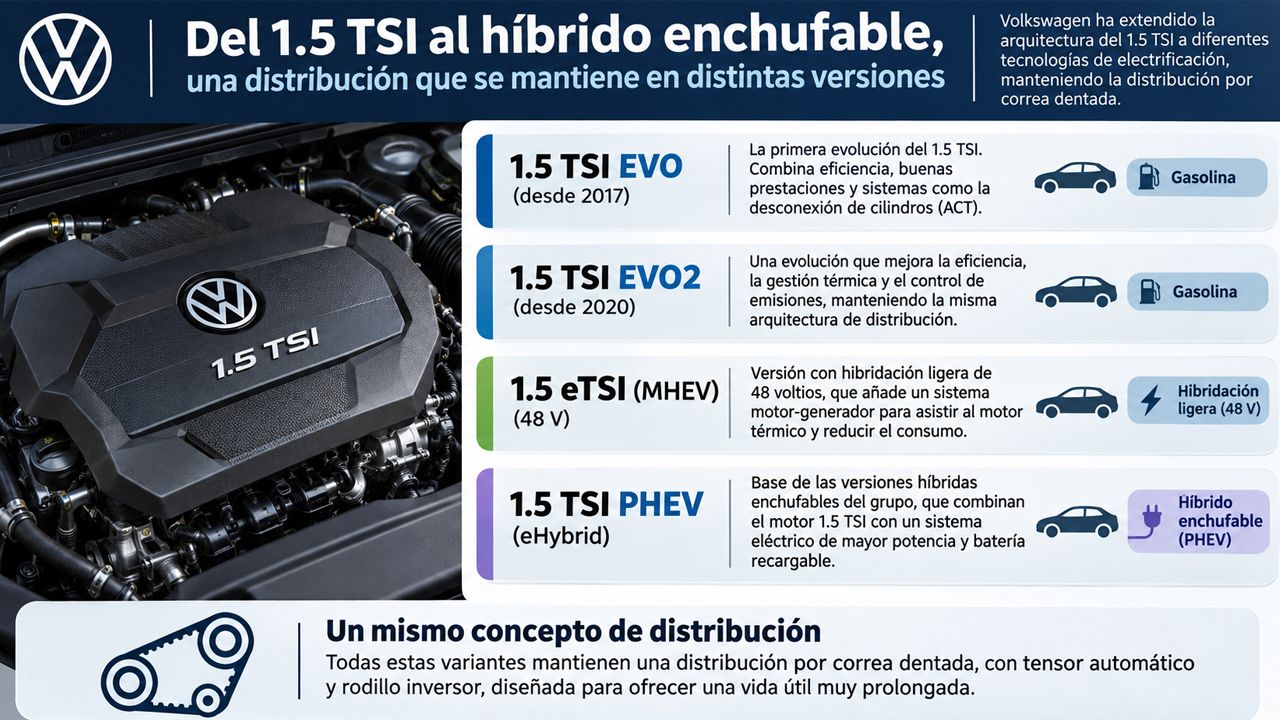
The 1.5 TSI EVO2, eTSI 48 V, and PHEV maintain this architecture
The manufacturer's technical documentation describes a timing system using a toothed belt with three elements located behind three covers on the left side of the block, two plastic and one intermediate made of aluminum:
- Automatic tensioner: maintains the proper tension of the belt during operation.
- Idler roller: or guide that directs the belt's path and supports contact and mechanical loads.
- Pulleys:for the camshafts and the crankshaft that transmit movement and maintain synchronization.
The problem is that these components incorporate mechanical elements subjected to wear, especially their bearings. Although some of these are already ball bearings because they better withstand friction, they can deteriorate due to:
- Fatigue of their tracks and rolling elements
- Loss or degradation of lubrication
- Aging of grease
- Temperature and vibrations
- Wear of their contact surfaces
In Volkswagen's theory, the system is designed to work for an extraordinarily high mileage. In fact, the same technical documentation found in ELSA (the technical information and workshop repair system of the Volkswagen Group) includes different inspection criteria depending on the version and application of the engine.
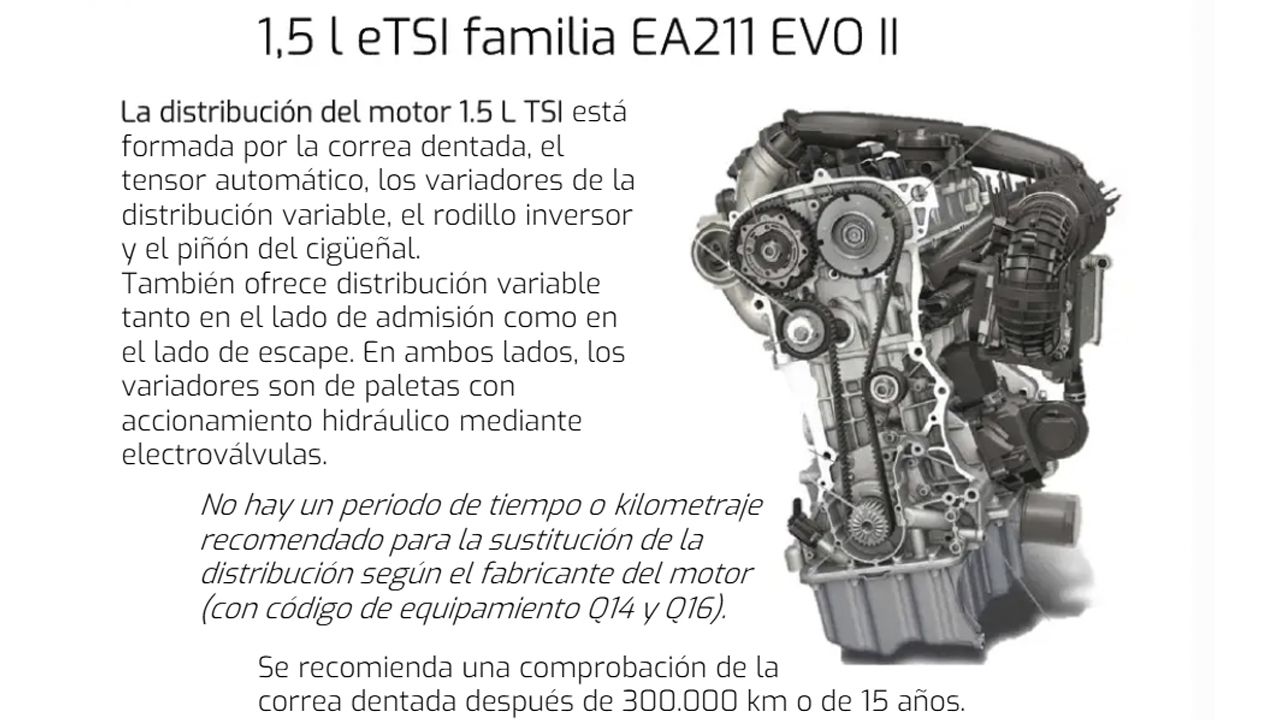
A timing belt designed to last 300,000 km?
In the Evo and Evo 2 configurations of the 1.5 TSI (the latter is used by the PHEV), an initial inspection is conducted starting from 210,000 kilometers, whereas the CUPRA documentation for the 1.5 eTSI with 48 volts -as you can see from these lines extracted from the technical training document for this engine in CUPRA- establishes a reference of 300,000 kilometers or 15 years.
This does not mean that the belt is guaranteed to last that long, but that the manufacturer considers it can operate for an extraordinarily long period before requiring inspection. It is also not a guarantee that all belts will reach that distance or an automatic order for replacement.
In fact, within the workshop environment, there are reports of units that have exceeded 280,000 kilometers with the original belt and a duration that could approach 330,000 kilometers under certain conditions. These durability references should be interpreted cautiously, as the mileage achieved by some units does not guarantee the same outcome for all.
In any case, we are talking about figures far removed from what we are used to finding in many conventional distributions. And here, one of the most particular characteristics of the engine emerges.
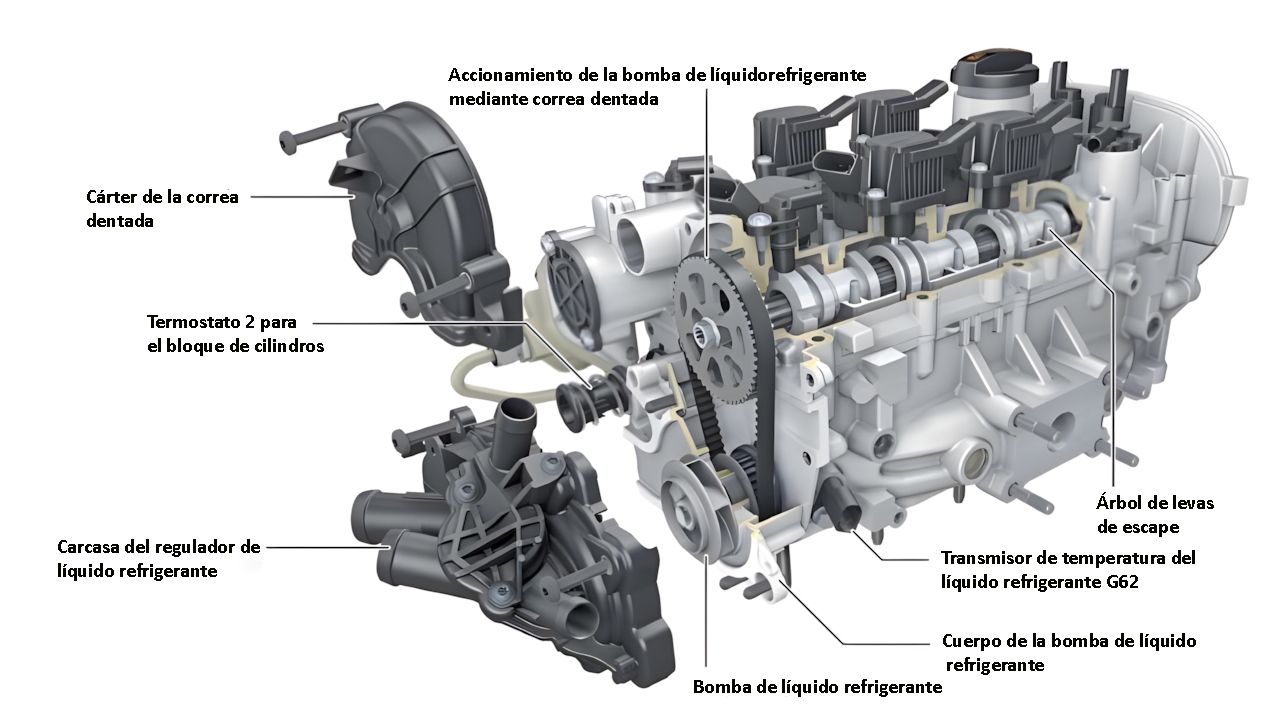
The water pump has its own belt and can complicate things
Another detail worth knowing is that the four variants of the 1.5 TSI engine do not use a single belt for all elements of their timing and cooling system. The water pump has an independent drive via another toothed belt, located at the opposite end of the engine compared to the main timing.
This means that both drives have different functions and that an intervention on the water pump does not necessarily imply replacing the main belt, although it is advisable to do so.
The 1.5 TSI represents both sides of Volkswagen's modern engineering well
The 1.5 TSI is a good example of how engine engineering has evolved. Volkswagen has managed to adapt a relatively compact gasoline mechanism to different electrification technologies, improving its efficiency and maintaining it as one of the central pieces of its offering.
Its belt-driven timing system is another example of this search for solutions that reduce periodic maintenance operations. Not having to replace it every certain number of years or kilometers represents a potential advantage for the owner, especially when compared to engines that require much more frequent interventions.
But one thing is to design a component to last a long time and another to easily know its condition when the vehicle accumulates hundreds of thousands of kilometers. And although the protection against contaminants is a technical advantage, it does not eliminate the natural aging of materials nor does it guarantee that all auxiliary components will have the same longevity.
Add us as a preferred source on Google and don't miss anything from Motenic.com

* This news is an AI translation of the original content. Motenic.com is part of Motor.es.