
Tesla Dodges Hardware 3 Future in Front of Shareholders
The latest Tesla earnings call left an eloquent omission. The management glossed over one of the most voted questions by its shareholders: what will happen to the millions of drivers with Hardware 3 who paid for an autonomous FSD that their cars cannot move.
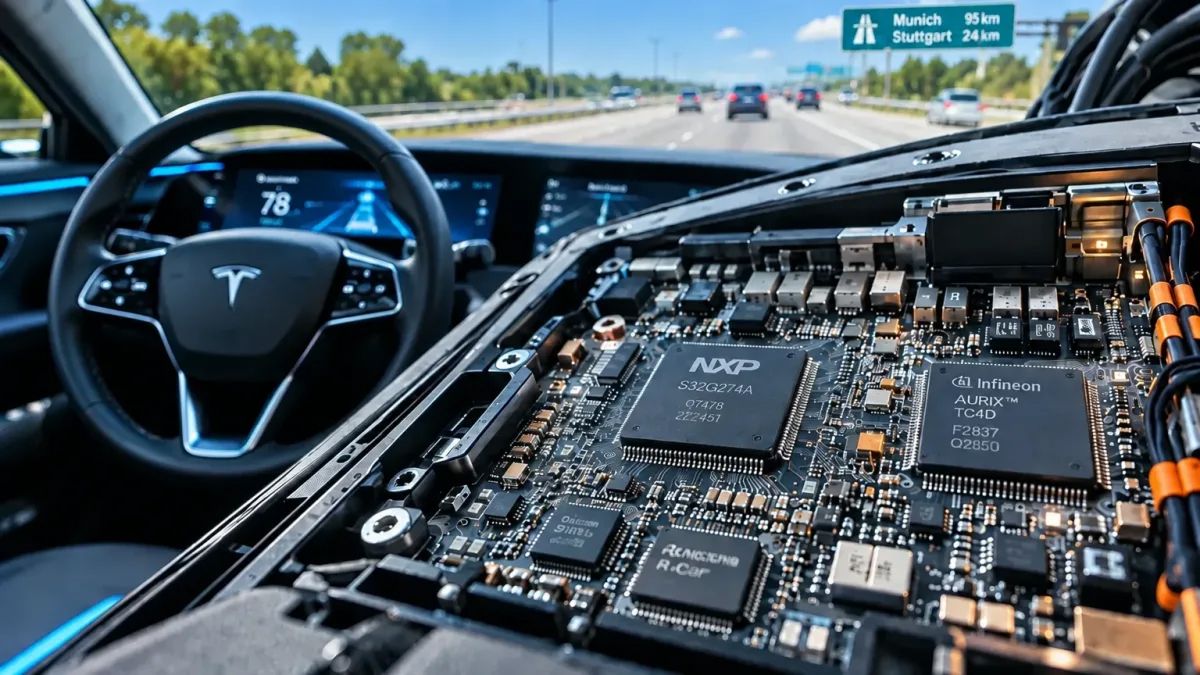

During the third-quarter financial results presentation, the Say platform once again channeled the doubts of the company's small investors. Those who closely follow Tesla know the mechanism: shareholders send their questions, others vote supporting them with the weight of their shares, and management responds live to the most supported ones.
On this occasion, the fifth question with the most support accumulated 557 votes and the weight of 652,900 shares. It posed a direct question: when will users of cars with Hardware 3 processors know if they will have a free equipment replacement and when will the brand present a clear plan. However, the company's investor relations officer, Travis Axelrod, read nine questions from the portal and skipped directly over this one.
A Deliberate Jump in the List of Questions
According to the U.S. media Electrek, the omission can hardly be attributed to oversight. Tesla indeed chose to respond to questions about the revenues from the Optimus robot or the mapping for the autonomous driving system, two topics that had less supported shares on the platform than the doubt about the processor of veteran vehicles. Even the training of Optimus was addressed, a matter that didn't even rank among the top ten in the voting.
The silence contrasts with the intervention of Ashok Elluswamy, head of artificial intelligence at the company, who did answer another question about when the autonomous system without supervision would reach customers' cars. His response set the horizon for the second quarter of 2027, linked to the FSD v15 version. It is a timeline oriented to the Hardware 4 processor, leaving the previous generation in limbo.
The origin of the problem was set by Elon Musk himself in early 2026, when he admitted in another conference that Hardware 3 lacks the technical capability to enable autonomous driving without supervision. The technical reason is evident: the veteran computer barely offers an eighth of the memory bandwidth managed by Hardware 4. That statement was a cold shower for those who had purchased the package trusting the promise that their cars came equipped with everything necessary from the factory.
Previous Promises Without Defined Dates or Costs
This is not a new issue on the company's agenda, although previous responses have been vague. In April of this year, Musk spoke about the possibility of creating microfactories in large cities to replace cameras and computers, and even suggested discounts for changing vehicles. Three months later, the brand's top officer pointed out that an update would make sense at some point, hinting at jumping directly to a future board or to the new generation AI5 architecture.
To this day, there is no official budget, timeline, or replacement procedure for users. The closest these vehicles have been to recent software has been the delivery of the FSD v14 Lite version, a trimmed variant that maintains the need for constant supervision and falls far short of the originally promised capabilities.
Let’s be honest: putting figures on this update represents a first-order financial problem. Replacing processors and cameras in an estimated volume of around 4 million cars, or financially compensating their owners, implies a gigantic cost. Every word spoken in an earnings call is also recorded for the courts, where pressure on the company continues to grow.
Class Actions Tighten the Noose
The autonomous driving package was initially marketed for amounts that reached up to 15,000 dollars under the explicit premise that the vehicle had all the necessary hardware. Given the lack of practical solutions, owners have turned to the courts through class actions in the United States, China, and Australia.
In Europe, the legal front is also advancing. In the Netherlands, a class action already gathers nearly 7,000 owners of vehicles with Hardware 3 backed by a law firm. Documentation from the Dutch regulator RDW also reveals a relevant fact: Tesla has only submitted for homologation for the advanced autonomous driving functions in Europe the vehicles equipped with Hardware 4 architecture.
Ignoring the question in front of shareholders saves uncomfortable explanations during a financial conference, but does not solve the real problem on the streets. There are millions of drivers who paid upfront for a function that their current processor cannot execute, and sooner or later the brand will have to clarify whether it will assume the renewal of the equipment or leave the matter in the hands of the judges.
Header image generated by AI

* This news is an AI translation of the original content. Motenic.com is part of Motor.es.
Fuente: Electrek