
QuantumScape Osprey: 1,000 cycles at ambient pressure change everything
The race for solid-state batteries has accumulated years of inflated lab promises. However, QuantumScape's announcement with its Osprey platform shows a technical parameter that often goes unnoticed: achieving 1,000 complete cycles at ambient pressure.


Every few months, a headline promises impossible energy densities and five-minute charges, only to find that the fine print requires lab conditions that would never fit into the chassis of a conventional car.
That's why QuantumScape's latest technical report on its new Osprey platform deserves a thoughtful read. Amid the usual noise of the sector, the standout figure is achieving 1,000 complete cycles while retaining 80% of its capacity at 1 atmosphere of pressure.
The big silent obstacle of sulfide cells
To understand why a simple atmosphere is significant news in electric cars, we need to look at what the chemistry of sulfides requires, as investigated by manufacturers like Toyota, Samsung SDI, or BYD. This type of solid electrolyte needs intimate and continuous contact between its particles to allow lithium ions to move without destructive friction. In the lab, that contact is achieved by compressing the cell with gigantic mechanical presses.
QuantumScape itself illustrates the magnitude of the problem clearly: subjecting a standard cell of 10 by 24.2 centimeters to a pressure of 20 atmospheres is equivalent to exerting about 5,000 kg of continuous force, the weight of three medium cars resting on a single cell. If we translate that requirement to a complete battery pack with hundreds of cells, the manufacturer is forced to design a structure of solid steel plates and tensioners that add enormous weight, steal useful space, and drive up manufacturing costs.
In many laboratories, work is routinely done at pressures of 30 to over 100 atmospheres, and even recent announcements from the Chinese FAW touted as a major success having cells of large format operating at 50 atmospheres. A design that depends on such mechanical clamps will hardly reach a street car at a reasonable price.
What QuantumScape has truly tested in the lab
The Osprey architecture proposes a hybrid solution regarding materials. QuantumScape maintains its well-known ceramic separator in front of the metallic lithium anode and adds a solid sulfide catholyte. According to data analyzed by Electrek from QuantumScape's technical document, a two-layer cell with a size of 50 by 65 millimeters has completed 1,000 charge and discharge cycles at 1C and 30°C while maintaining 80% capacity, operating at that ambient pressure of a single atmosphere.
[PHOTO 1 · Caption: QuantumScape's Osprey platform reaches 1,000 complete cycles operating at ambient pressure. · Alt: Comparative technical infographic on required pressure and metrics of QuantumScape Osprey alongside an electric car charging.]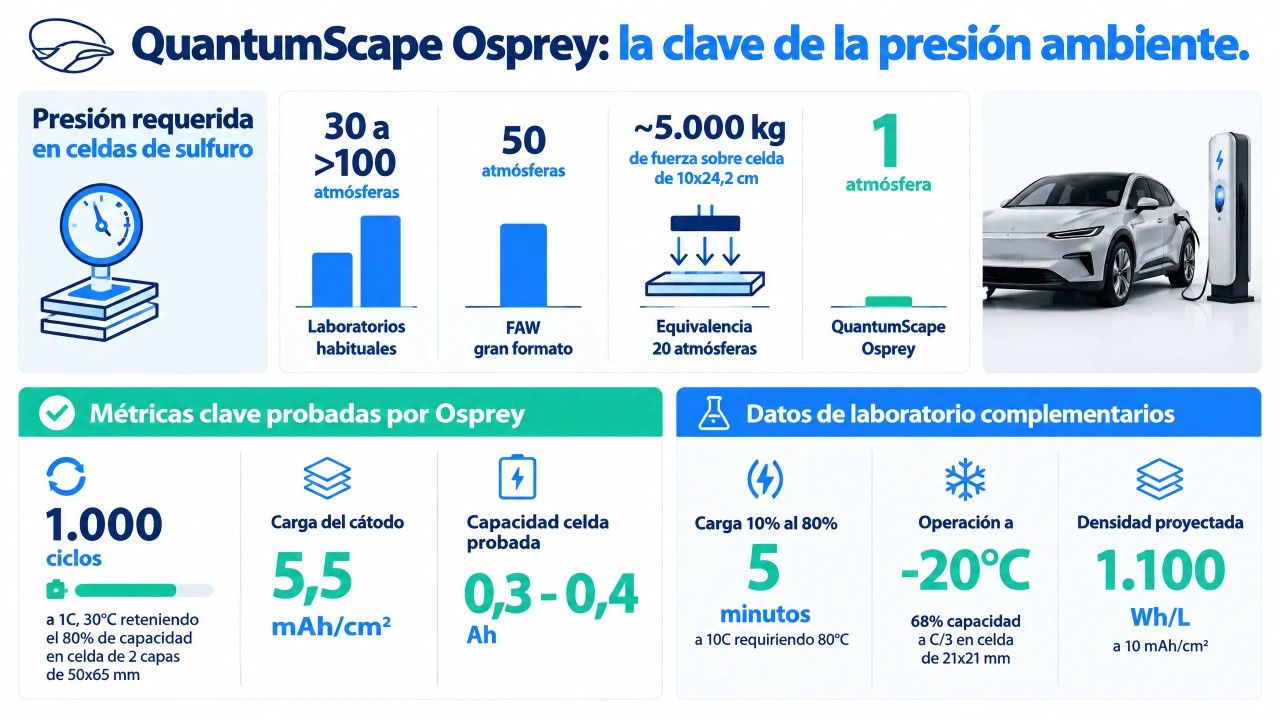
The load of the catholyte used in that trial was 5.5 mAh/cm², a figure perfectly aligned with current commercial cells. However, we must be clear about what still needs to be demonstrated. That test was conducted on a small cell of just two layers, whose calculated capacity hovers around 0.3 to 0.4 Ah, far from the 5 Ah delivered by its pilot cell QSE-5.
The rest of the published data also requires keeping our feet on the ground:
- Charging in 5 minutes from 10% to 80%: was achieved at a rate of 10C, but required heating the cell to 80°C, a temperature well above the usual thermal preconditioning of any vehicle on the road.
- Operation in the cold at -20°C: was demonstrated retaining 68% of its ambient capacity, but in a tiny single-layer cell of 21 by 21 millimeters and under a very slow discharge rate (C/3).
- Projected density of 1,100 Wh/L: is a future estimate for cathodes with 10 mAh/cm². The preliminary trial supporting that idea was conducted in a button-type cell for only 100 cycles and at 3 atmospheres.
A strategic shift towards open production
Beyond the lab numbers, the move entails a relevant industrial decision. QuantumScape offers Osprey as an open platform: car manufacturers can either use QuantumScape's patented sulfide catholyte or integrate their own solid cathodes developed in-house. QuantumScape claims to have already tested functional cells with cathodes supplied by its own automotive customers.
Getting the solid electrolyte to work without the need to pack the car in a hydraulic press is the logical step that separates a flashy experiment from a real automotive component. QuantumScape still needs to scale these small two-layer cells to commercially viable multi-layer formats, but demonstrating 1,000 cycles at ambient pressure finally marks a technical direction that makes sense in the real world.
Header image and infographic generated by AI

* This news is an AI translation of the original content. Motenic.com is part of Motor.es.
Fuente: Electrek